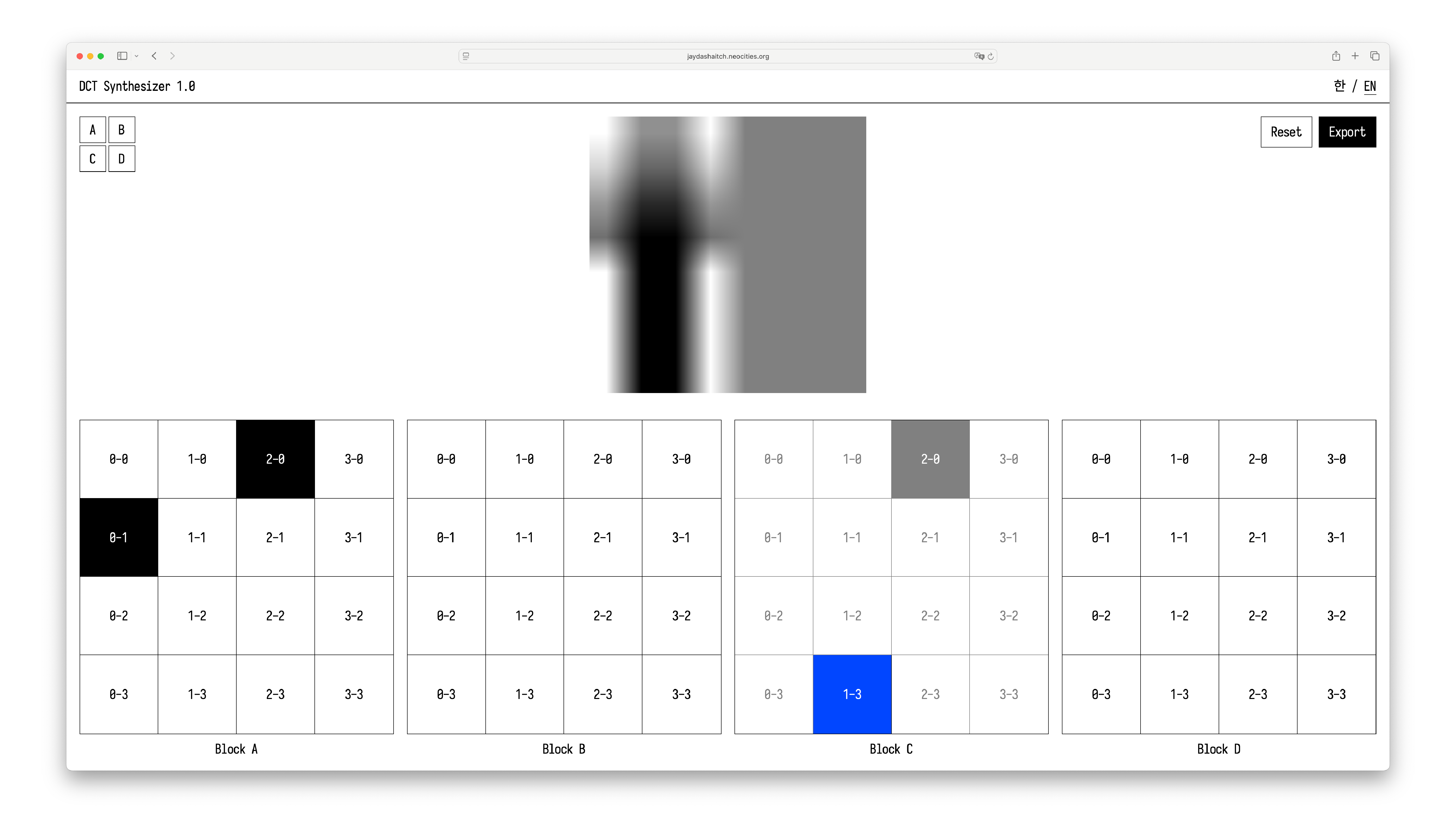
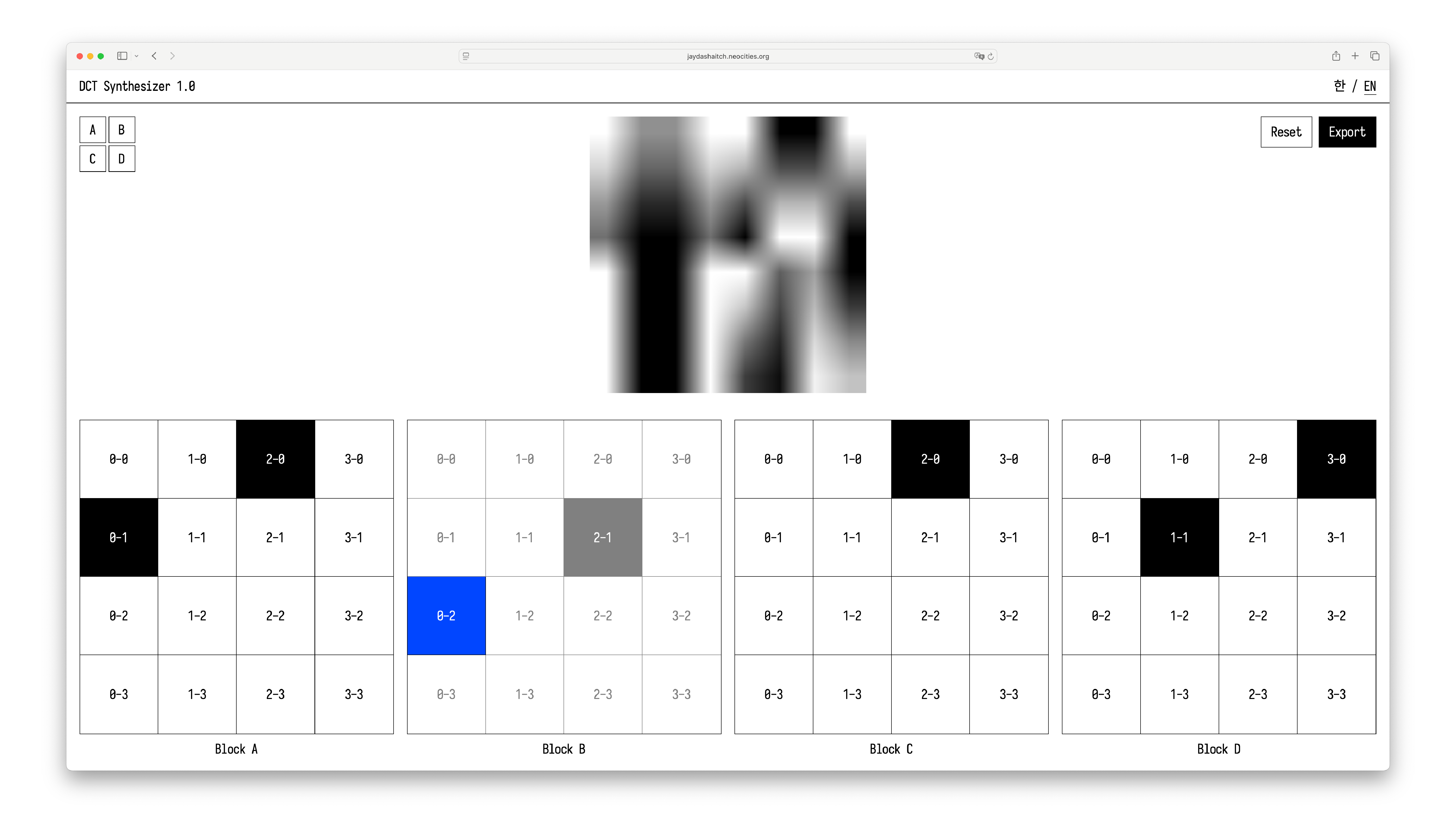
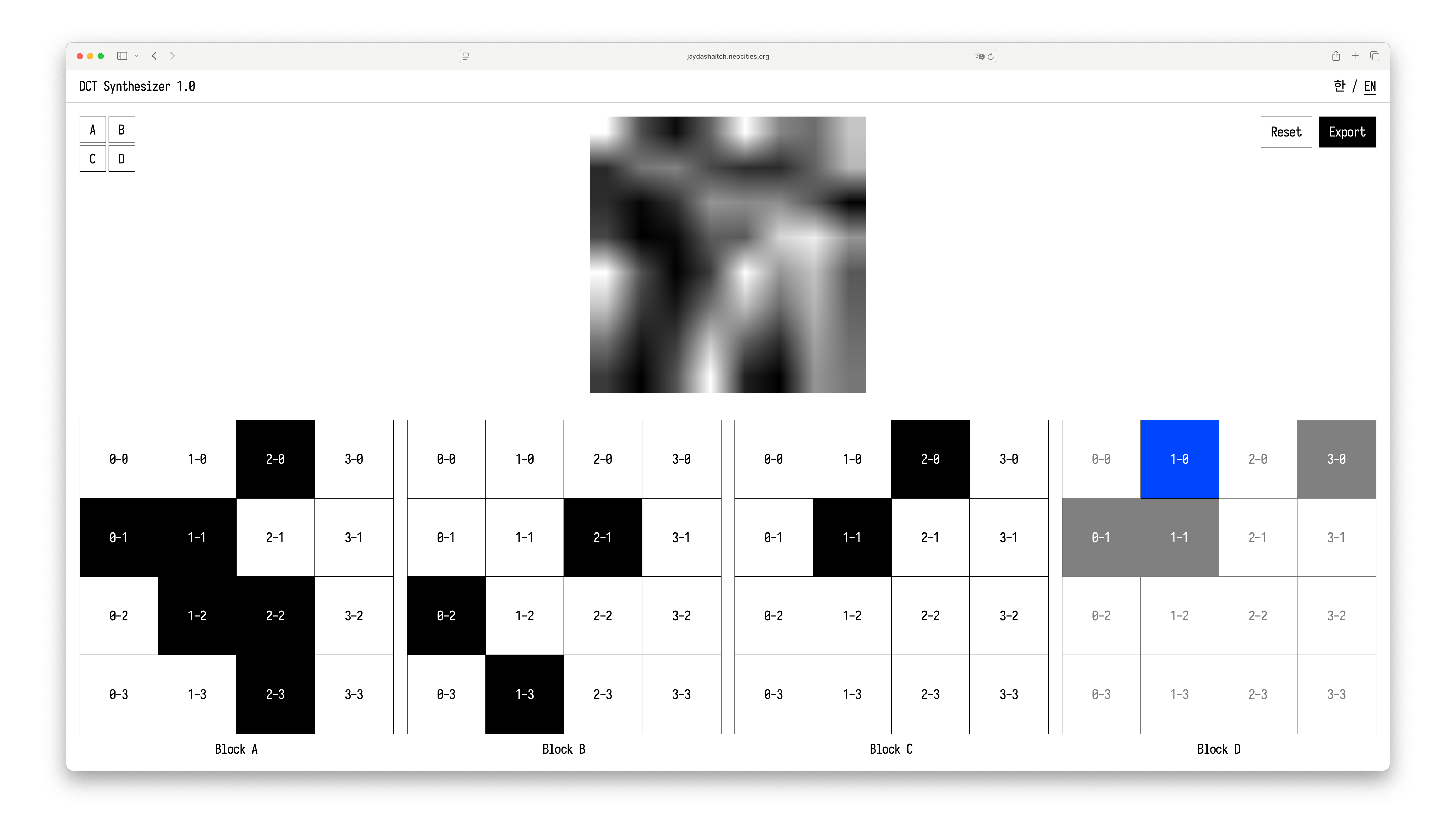
As explored in Workshop about “Synthesizer”: DCT Synthesizing I, the JPEG image compression process possesses the potential to generate shape images through the synthesis of multiple frequencies. This project synthesizes images by applying the DCT principle used in JPEG compression in reverse.
DCT Synthesizer 1.0 synthesizes an 8×8 resolution shape image by arranging four DCT blocks in a grid pattern.1 The PNG image users can export is a bitmap image resampled to 1000×1000 pixels, with interpolation applied for continuous visualization of the frequency structure.
Each cell in a block is represented in X-Y format, indicating the vibration frequency in the horizontal direction and the vibration frequency in the vertical direction, respectively. For example, ‘1-0’ has a lower frequency vibration count in the horizontal direction than ‘3-0’, and ‘0-1’ has a lower frequency vibration count in the vertical direction than ‘0-3’. As the frequency vibration count increases, and as the horizontal and vertical frequencies mix more, increasingly complex forms emerge. In other words, this means that in an image created using the DCT principle, complexity increases as the coefficients in the high-frequency domain become higher.
The original JPEG compression principle operates by simplifying these high-frequency domain values. This implies that complex shapes must be smoothed out to enhance image compression efficiency. However, my purpose in addressing the DCT resynthesis principle is closer to the opposite. Here, complex shapes are not targets to be efficiently removed, but objects of potentiality holding new possibilities. Accordingly, the ambiguous and blurred shapes produced by the DCT synthesizer 1.0 become potential images processed through a Ulysses algorithm.
-
Images compressed using the JPEG method are composed of 8×8 pixel blocks, each of which repeats as many times as needed to fill the entire image, starting from the top-left corner. ↩